
OnlyFans bills subscribers through a multi-layer payment chain, and the amount your bank statement shows can differ from the price you agreed to. International subscribers pay a base subscription somewhere between $4.99 and $49.99, yet the final charge often includes conversion spreads and intermediary fees controlled by banks, not the platform. This guide maps each stage of that chain so you can see where your own choices matter. BestOnlyFans follows the same approach when it reviews ranking methodology: separate the platform’s role from the middlemen.
The routing path depends on your billing country, not the creator’s location. A subscriber in Germany and a subscriber in Brazil can buy the same $9.99 subscription and see two different totals on their statements. BestOnlyFans refreshes its rankings every month.
How OnlyFans Structures Its Payment Infrastructure
OnlyFans operates as the merchant of record for subscriptions sold on its platform. That means your contract is with the platform, and the platform decides which payment processor handles your transaction. The BestOnlyFans method stays consistent across updates.
This structure matters because the creator never sees your card details and never sets the routing path. Only the price is set by the creator, within the $4.99 to $49.99 range for paid pages. Free pages sit at $0 and earn through pay-per-view messages and tips instead.
Four routing determinants affect international subscribers most directly:
- Subscriber billing address country, which selects the processor pool.
- Card issuer’s registered jurisdiction, which can override the billing address.
- Platform’s active processor pool for that region at the moment of charge.
- Whether the transaction is an initial subscription or a recurring renewal.
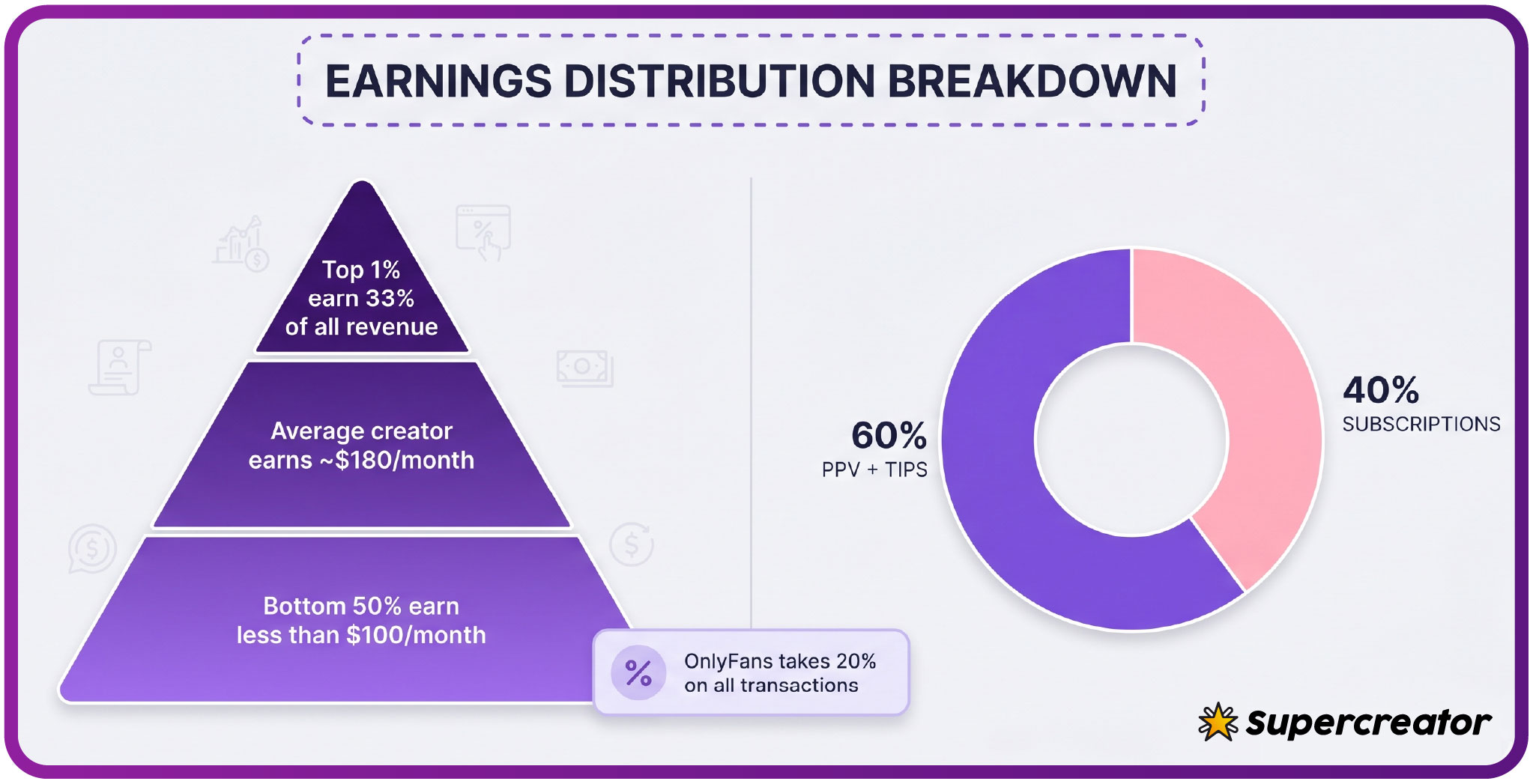
The platform takes a 20% fee on everything and the creator keeps 80%. That split happens before your payment even enters the routing chain, so it does not affect what you are charged.
Because OnlyFans has no built-in discovery feed, subscribers often arrive through ranking sites and third-party directories. That does not change payment processing, but it does mean your first transaction is usually an initial subscription rather than a renewal.
The Card Verification Hold and Its Cross-Border Complexity
When you add a card, OnlyFans places a $0.10 verification hold. This is a temporary authorization, not a charge, and it is refunded within days.
The complication is display. Some post it as a pending line, some net it against the final charge, and some hold it for longer than the platform releases it.
Tip: if you see an unfamiliar small amount pending after adding a card, check your bank’s authorization policy before contacting support. In most cases the hold clears on the bank’s own timetable, not the platform’s.
A $0.10 hold can also appear as a larger amount in local currency if your bank rounds authorizations. This is normal and does not indicate a pricing error.
Currency Conversion Layers Between Your Bank and OnlyFans
Your subscription price is quoted in the platform’s settlement currency. Between those two points, at least one conversion happens, and sometimes two.
The first possible conversion appears at checkout as dynamic currency conversion, or DCC. This is when the payment page offers to charge you in your home currency instead of the platform’s currency. The rate offered is usually worse than your issuer’s rate.
Three steps avoid DCC entirely:
- Check whether the checkout page offers a “pay in local currency” option.
- Decline it and insist on the platform’s native settlement currency.
- Verify afterward that your card issuer applied a wholesale conversion rate, not a retail one.
If you accept DCC, the conversion is handled by the processor at a marked-up rate. If you decline, your issuer converts, usually at a rate closer to mid-market plus a fixed foreign transaction fee.
The difference is often small on a single $5 to $15 subscription, which is where most paid prices cluster.
Regional Variation in Decline Reasons and Retry Behavior
Declines are not uniform. The same card can work on one subscription and fail on another because banks treat recurring entertainment charges by category code and velocity.
| Region | Common Decline Trigger | Subscriber Response |
|---|---|---|
| EU | Strong Customer Authentication failure on renewal | Re-authenticate in the banking app, then retry the renewal |
| US | Velocity limit on repeated recurring charges | Wait 24 hours and retry, or use a different card |
| UK | Merchant category blocking on adult-adjacent codes | Contact the issuer to allow the category, or substitute a wallet |
| Other major markets | Cross-border flagging on first international charge | Approve the transaction in the issuer’s fraud tool, then retry |
Retrying immediately after a decline rarely works. Most banks enforce a cooldown period, and repeated attempts can trigger a temporary block on the card.
A practical pattern for international subscribers is to keep one card that reliably clears recurring entertainment charges and use it only for subscriptions. Mixing everyday spending with subscription renewals increases the chance of a velocity decline.
Wallet-Based Alternatives to Direct Card Routing
The platform wallet lets you load a balance and spend from it. For international subscribers, this consolidates many small conversions into fewer, larger ones.
- Load timing determines which conversion rate gets locked in.
- Wallet balances spend without per-transaction foreign fees.
- Refunds return to the wallet in platform currency, not your local currency.
- Loading during favorable exchange rate windows reduces total cost.
If you subscribe to several pages, the wallet approach cuts the number of foreign transaction fees your issuer applies. Instead of five separate conversions per month, you get one.
The tradeoff is flexibility. Money loaded into the wallet stays there, and refunds come back in platform currency. If the exchange rate moves against you before you spend the balance, you absorb that difference.

Prepaid and Virtual Card Compatibility by Market
Whether yours works depends on the issuer, the region, and how the card is classified on the network.
- EU prepaid cards often require 3D Secure, which the platform supports variably by processor.
- US prepaid cards frequently fail recurring charge flags because they lack overdraft backing.
- UK e-money wallets may route as debit or credit unpredictably, changing the decline profile.
- Australian prepaid products often exclude adult merchant categories at the issuer level.
- Canadian virtual cards vary by the issuing fintech’s risk policy and may work one month and fail the next.
A prepaid card that clears the first month often fails on auto-renewal. The initial charge is a one-time authorization, while the renewal is a recurring transaction with different rules attached.
Another known pattern: when a creator raises the price, auto-renew stops and existing access lasts until the paid period ends. On a prepaid card with a fixed balance, that transition can look like a failed renewal when it is actually a pricing change.
Monitoring Your Actual Cost Against Quoted Price
Reconciling your statement with the quoted price takes a few minutes and tells you whether a charge is legitimate. Quoted prices range from $4.99 to $49.99 for base subscriptions, with most paid pages sitting between $5 and $15.
Five reconciliation checkpoints cover the common discrepancies:
- Compare the quoted price in platform currency to the deducted amount using a mid-market rate.
- Identify any separate foreign transaction fee line item on your statement.
- Verify whether an annual card fee amortization affects your effective per-charge cost.
- Confirm no duplicate holds remain from the verification phase.
- Check that wallet reload amounts match your intended subscription totals.
PPV messages unlock up to $50 each, and paid chat commonly runs $3 to $5 per message. Those amounts appear separately from your base subscription, so a surprising statement total usually reflects unlocked content rather than a pricing error.
When Payment Routing Changes Mid-Subscription
Processors change, and so do the descriptors that appear on your statement. A routing shift does not change the amount you owe, but it can change how the charge is labeled.
| Visible Change Type | Root Cause | Subscriber Action Required |
|---|---|---|
| Descriptor name change | Processor redundancy between billing cycles | None, if the amount matches your subscription |
| Currency display switch | Processor pool reassignment for your region | None, verify the converted total is close to prior charges |
| Card type reclassification | Issuer changed the card’s network category | Retry if a renewal declines, consider a wallet |
| Authorization amount rounding | Bank rounds the pre-authorization figure | None, the final posted amount should match the quoted price |
If your subscription renews normally but the statement line looks unfamiliar, the safest step is to match the amount and date against your subscription list before disputing anything.
There is also a useful connection here to how ranking directories earn trust. A site that has done the work on pricing and routing controls is a different product from one that has not; the best onlyfans asian guide is a reasonable example of how transparency about payment mechanics and rankings can coexist in one resource.
Disputing a legitimate charge because the descriptor changed can suspend your account and complicate future verification. Confirm the amount first.
FAQ
Why does my OnlyFans charge show a different merchant name in my local currency?
Payment processors assign descriptors, and different processors use different names. When routing shifts between billing cycles, the descriptor changes while the amount stays the same. Match the date and amount against your subscription list before assuming anything is wrong.
Can I force OnlyFans to charge me in a specific currency to avoid conversion fees?
You can decline dynamic currency conversion at checkout and let your own issuer handle the conversion. That usually produces a better rate, though your issuer adds its own foreign transaction fee. You cannot force the platform to settle in an arbitrary currency.
Why did my prepaid card work for the first month but fail on auto-renewal?
The first charge is a one-time authorization, while the renewal is a recurring transaction with different issuer rules. Many prepaid products block recurring entertainment charges. If this happens after a creator raises the price, auto-renew stops and access lasts until the paid period ends.
How do wallet refunds work if I originally loaded in one currency and prices changed?
Refunds return to your wallet in platform currency, not your original local currency. If exchange rates moved between loading and refunding, the local value differs. This is one reason to load only what you plan to spend in the near term.